Showing posts with label knowledge. Show all posts

Tuesday, April 19, 2011

Positive and Playful Parenting

OK, so I have been receiving some great "share it forward" e-mails from one of the community child educator programs that is around good old Saskatchewan.  I keep meaning to post them and "share them forward" for all of you too but it just keeps getting set to the side..... So finally here is one.  I find alot of theses quick messages to have some great tips and even ideas on what to do with your children and family often.


Positive Parenting is simple steps that can make parenting fun and easy.

Everyone no matter the age learns and grows better in a positive environment.  If you praise instead of criticizing there will be no resentment. Think about how you would feel if your boss continually pointed out all your mistakes and never praised you. Criticism breeds resentment, causes others to justify their behavior, wounds the others sense of importance, and destroys the person’s sense of pride, even children. 

Think about the flip side, when your boss praises you how to you feel?

Praise your child for what they do well not what they didn’t do right. This will leave your child feeling happy. Children like everyone else, likes to feel valued. Children will continue the praised behaviour. Use positive parenting to raise your child in the best environment possible.

§ Praise and encourage appropriate behaviour.
§ Show affection for your child.
§ Recognize her accomplishments

Children learn best through play.
Playful parenting understands the importance of play in a child’s life. Playful parenting is an effective way to learn more about what your child is really feeling. Children tend to open up when things are more relaxed and things are easy going. Positive interactions are more likely to leave a lasting impression of trust and belief in you as a parent. Remember that you’re always building a relationship, if you use positive parenting, this will keep the pathways to communication open. If your child trusts and is comfortable, your child will always come to you when there is a problem and it will be easier for you to engage your child in conversation.

Interactions between parents and children are important for laying the foundations for the child’s social and emotional development. Becoming a playful parent will provide the right emotional setting for you and your child to bond with each other gracefully. Playing can be a way to identify with your child. Think about how you felt when your parents played a game with you? Did this leave a lasting impression for you? How did you feel towards you parents, more open, more positive, and more relaxed? Remember this when you play with your child. You are not only bonding but creating lasting memories.
Do fun things together as a family, such as:
§ Playing games
§ Reading
§ Going to community events

* thank you to the team that puts Share it Forward together!

Tuesday, March 8, 2011

A rainbow and snack

Our St. Patrick's Day craft started today with a snack and craft in one.

We made rainbows out of Fruit Loops and Cheerios. First I had the children sort the Fruit Loops by color and of course they were eating just as many as they were putting in the dishes!  This was great because we were able to do a number of activities and learning experiences at once. 
  • Snack
  • Learning colors (for those that don't know their colors yet)
  • Sorting/math skills
While the children finished sorting the colored Fruit Loops, I was making the outline of the rainbow.  I wasn't able to find one that I liked from the Internet so I decided to do it myself.  I imagine if I took some more time I would have found one, but instead I just drew two clouds at the bottom of each paper and connected them with one big loop for the starting of the rainbow.


What you need:

  • Heavy paper (card stock) in the colour you choose
  • Glue
  • Fruit Loops
  • Cheerios
  • Template of a rainbow


Directions:

  1. Have the children place glue along the top row of the rainbow and place the red fruit loops long it
  2. Continue the first step until you reach the final color (each row will get smaller and smaller)
  3. Place glue inside the cloud and use the cheerios for this


Colors of the Rainbow in order:

  1. Red
  2. Orange
  3. Yellow
  4. Green
  5. Blue
  6. Indigo
  7. Violet (Purple)

Of course we skipped the indigo cause Fruit Loops don't come in that color!!!!


Other ideas: 

Instead of fruit loops you could use
  • beads
  • buttons
  • tissue paper
  • colored pasta
  • colored rice

Instead of the cheerios you could use
  • cotton balls
  • white tissue paper
  • rice
  • pasta
  • white buttons
  • white beads
Remember to check out Ducky's Photos for more pictures of today's craft

Wednesday, February 23, 2011

Update!

Please note that I have now added a few extra pages to Ducky's Life.

1: Ducky's Weekly Food Meny
2: Ducky's Photo's

You can find links to these pages on the right hand corner of the blog page.  I hope you all enjoy and remember to check back often! 

Every time a do a new post I will add additional photo's in Ducky's Photo's, so feel free to take a long.

Thank you for follow along with Ducky's and our activities we do!!!

Thursday, February 17, 2011

A review from Experience

So over the last while I have tried a number of different activities and crafts with my children and the ones in my care.  We have done letters or numbers assigned to the week and I have also done weeks of just concentrating on a certain object or theme.  I have found that most of the children in my care and younger and the numbers and letters seem to be a little to advanced for them still.  On this note I think I might set those to the side and base my weekly crafts and activities on themes instead.  It will more a less be the same but instead of that letter Aa, we will work on birds or transportation, and continue learning about that theme for the full week.  I know my own daughter loved the letters we were learning so I will continue teaching her on the side, in the evenings and on the weekends.  I will continue posting our weekly activities and crafts for all to see, but I just wanted to send a quick note out to you all that things have changed a bit.  I will round this week off with finishing the letter Bb, and we will start our new lessons next Tuesday as Monday is a holiday here (Saskatchewan). 

Thank you for following along with Ducky's Arts and Activity Centre and I hope you enjoy the new program!

Friday, February 4, 2011

A is for....

The letter Aa.....

While a number of the children in my care are fairly young, I find it nice to still start teaching them the alphabet.  Sure they might not have a clue what I am talking about, it helps them with crafts, memory, and fine motor skills.  I print out the letter for the week so they can trace them on the lined sheet, just like the big kids in kindergarten do!  My daughter loves this cause she gets to do what her big brother is doing at school, but only doing it at home with mommy.  I planned a few snacks around the letter Aa, and also made sandwiches into the shape of an A too.  Now I am a little slow in times and totally forgot to take pictures of our activities this week. I promise I will try harder with our activities to come.

Here's what we did for the week:
  • Coloured and cut out Alligators and glued them on to colored paper
Craft can be found at: Alligator by DTLK


  • Made Apple pie (wow that's a task with a 2 1/2 year old and a 4 year old!)
See below for our wonderful recipe


  • Coloured Apple pictures
Coloring page can be found at: Apple Colouring Page  by DTLK


  • Traced the letter Aa
Tracing page can be found at: Learning to print Aa by Kids Learning Station


  • Cut out and pasted some words that start with Aa and the letter Aa by itself
Aa is for: apple, airplane, ant, Alanna, Aliyah, Ashley, Apple Pie, alligator

  • Made applesauce for a snack
See recipe below.


  • Cut apples in half to show the kids that the seeds make a star in the inside (then of course we ate them as a snack afterwards!)
Tip: cut apple through the middle horizontal not vertical


Apple Pie Recipe:


Basic Pie Dough Recipe

Makes one double crust pie or 2 single crust pies.
Ingredients:
2 cups flour
1 teaspoon salt
2/3 cup shortening or lard
2 tablespoons cold butter
4-7 tablespoons cold water

Directions: 

Sift the flour with the salt. Cut in the shortening until the mixture looks like small peas. Cut in the butter coarsely. The addition of the butter makes a flaky pastry crust. Sprinkle this mixture with water a tablespoon at a time and mix lightly with a fork. Keep adding water 1 tablespoon at a time, just until dough will come together when you mix it with the fork.Gather the dough into a ball. Dough can be refrigerated until ready to use at this stage. If using now, divide the pastry into 2 sections, one just slightly larger than the other. Take the larger ball of dough and roll it out into a large, thin circle with a rolling pin. Make sure you sprinkle a bit of flour on the surface you are rolling the dough out on before you begin. Use the larger sheet of dough as the bottom crust of a 2 crust pie. Roll out the other piece for the top.

Follow directions on the pie recipe for how to bake the pie.

Apple Pie Filling Recipe


Ingredients:

5 to 6 cups apples, peeled and thinly sliced
1/2 to 3/4 cup sugar (to your taste and depends on the sweetness of the apples)
3 tablespoons flour
1 teaspoon cinnamon
dash salt
2 tablespoons cold butter

Directions:


Preheat the oven to 425ºF.
Lay 1/2 the pastry, rolled out to about 1/8" thickness, in the bottom of the pie pan and press it in gently to lay flat in the pan. Leave the excess crust hanging over the edges for now.
Place peeled, sliced apples in a bowl. Mix together the sugar, flour, salt and cinnamon. Pour over sliced apples and mix. Fill the pie pan with the apples and pat down with a spoon. Dot the filling with pieces of butter. Moisten the lip of the pie pan with water. Place the top layer of rolled out crust over the filling, making sure crust reaches outer edges of the pie pan all around. Seal the edge and flute all around (see notes below for how to flute a pie edge). Take a fork and prick the pie top in several places to create vents for steam to escape. Bake for 50 minutes, until pastry is golden and the filling is bubbling through the vents.
Let cool a bit before cutting to allow the filling to settle

 Apple Sauce Recipe ~ By AllRecipes.com

Ingredients

  • 4 apples - peeled, cored and chopped
  • 3/4 cup water
  • 1/4 cup white sugar
  • 1/2 teaspoon ground cinnamon

Directions

  1. In a saucepan, combine apples, water, sugar, and cinnamon. Cover, and cook over medium heat for 15 to 20 minutes, or until apples are soft. Allow to cool, then mash with a fork or potato masher. 
A nice simple recipe for kids to help with, doesn't take a lot of time and you can even add berries or other fruit to the apple mixture while cooking for a great change in flavor!

Chompers

I mentioned in my previous post quickly about teething.  Its another step in growth for our babies, another step to independence too.  Yep, that means as they get more teeth they are growing up and soon will want to feed themselves and eat from the table not that yummy baby food (that was said in sarcasm, in case you didn't know).  My youngest son is 10 and a half months old right now and wow, time is flying that's for sure.  Some days its doesn't seem to go fast enough either for the both of us, with these darn teeth trying to come in and there isn't alot that I can do to make them come in, all that is possible for me to do is comfort him and try the best to sooth his pain.

Children usually start teething around the age of 3 months, some younger, some older, and some are even born with a tooth or two (Wow, I couldn't imagine that, but its true), and teething usually last till the age of two or so.  That's along span of time but remember that they aren't teething 24-7 for those two years, its on and off.  I remember when I had my first son, I had heard so many horror stories from parents and teething infants.  I think teething was the one things I worried about from the time I was 6 months pregnant until I realized my boy was now 4 years old and it was already over (he is 6 now and I can hardly remember the days he was teething).  For many children cutting teeth is horrible for them, they have all the side effects that go along with teething, yet for the next child you don't realize they have cut a tooth till one day they decide to take a chomp outta your finger!  Some teeth come in in a matter of a day while others seem to move up and down for what seems likes weeks, before they break their way through the gum line and show that pearly white off to all who can see it.

Most (and I must point out this out, MOST) children's teeth come in the same.  All is a pattern which usually follows something like this:  the two lower middle teeth; next, the four upper middle teeth arrive, and after that come incisors, the furthest forward molars and finally the back molars. The first teeth may be the easiest for many babies because the teeth are sharp and thin, so they make it through the gum tissue with less trouble than the broad molars do.  Now I must admit not all children's teeth come in this way, like some youngest son for instance, he cut is left top front tooth first out of the 4 front middle ones.  I must say he did look a little funny for a few weeks until he got the bottom ones and then followed the other top three.  A tooth to the side all by itself?!?!? 


Some signs of teething are obvious; drooling, wakefulness, crankiness, crying, biting, chewing and tender gums are a few. Other signs of cutting teeth may be a little less obvious: they refuse food or may not be drinking milk; he or she may have a rash around the mouth; saliva irritates the delicate skin. There may be a runny nose, the mechanics of which escape me, but if you've ever eaten a hot chili, you know that your mouth floods with saliva, your eyes tear up and your nose starts to run. Because the baby is drooling and swallowing more drool than you ever thought possible, you may notice loose stools in the diaper. Loose bowel movements may be a part of teething, but if there's anything more than an extra-poopy diaper, if there is fever, mucous or blood in the stools, or if the diarrhea is violent, you should take your baby to the doctor for help because the diarrhea probably isn't related to teething. And if your child is experiencing even the mild diarrhea associated with teething, there may be diaper rash, too. And you thought this couldn't be more fun!

The pain of teething is normal, and often not bothersome enough to disturb your baby's good mood or even sleeping habits. But, many parents discover that cutting teeth causes their infants to become restless and irritable, interfering with sleep as well as eating. When your baby can't sleep because of teething pain, there are several methods you can use to help comfort her. You can use topical medicines to anesthetize the sore gums; internal pain medications in pill or liquid form can reduce the pain perception at the level of the brain, homeopathic remedies can stimulate the body to produce its own pain relief and home remedies like cold foods, massage and things to bite on can either numb the gums or reduce the pain from pressure. You have a lot of options, and when your child is having a tough time with teething, you may want to try them all! Start with the simple things first: they often work best..
 

You can soothe sore gums by letting your child chew or suck on chilled teething rings, frozen baby bagels or popsicles, but when teething pain causes your child trouble sleeping, you may decide to turn to medicine to help you and your baby get some rest. Baby versions of both Motrin and Tylenol are available, and you can get your child's correct dosage of Ibuprofen you’re your pharmacist. Some parents find that their infants do better with one medicine than with another, so you may want to try one first and then compare their effects.


binkies in the fridge so you can swap for a cool one once in awhile. Lots of parents say that letting their child suck on a cold, wet washcloth helps, and even thought it's a homely sort of remedy, enough people swear by it that it would be wrong to ignore the advice. The other bonus is that the washcloth can absorb some of the drool that can otherwise drench an infant from head to toe. Pain gel is another option for daytime, deadening sensation in the gums and mouth for a relatively short period of time. But if it helps relieve the pain even for a little while, it may make the difference between sleeping babies and screaming ones. When your child is in pain, you want to do whatever possible to make it better: stockpiling medicine, oral gels, teething aids and tips from your friends may be able to help you through the worst of teething.

In conclusion, teething maybe a sinch for some infants while others can go through hell.  Remember that it will be over soon and then you get to move on to the next stage of growing up..... the potty training!!!! Take every moment, experience, and situation at a time and remember it cause all to soon they will be grown up and having to experience these things themselves with their own children.

Wednesday, January 26, 2011

Potty Training

Well this month has been slow for my daycare, I still have two large hurdles I am trying to deal with.  One is potty training 2 children and the other is 2 children teething (this will be a blog to come!).

I have a just about 3 year old and a 2 and a half year old that are trying to be potty trained right now.  This is a experience I really did not enjoy with my first two children!!!!  But it has to be done. 

One has to remember that every child learns at their own pace and just cause they are slower with one thing in life doesn't make them slow at everything else.  When choosing to start potty training a child you must first and for most look and assess them to see if they are truly ready to try this task and experience.  From some children, just like adults, when they fail at something it can really devastate them. So if they are not ready to start learning then don't push them. 

Once you get the aspects and rules/guide lines taught to your child, please, please, please remember that accidents will happen even when they have accomplished the basics of going on the potty.  When accidents do happen, don't go off the deep end and lose it on the child, because this can lead to set backs and self esteem problems too.  Just because they are 2, 3, 4 years old, does not mean that when you yell or get mad at them that it doesn't hurt their feelings, they are humans too. 


ABC of potty training

Click here to find out more!

Most parents eagerly anticipate potty training as a milestone in their child's development -- if for no other reason than that it means an end to changing diapers. But few moms and dads are prepared for how long it can take. Yes, some children get it within a few days. But many more take several months. You and your child have a better chance of success if you know the basics of training and can make the process clear to your child.

A -- Assess your child's readiness

Most people begin training when their child is about two, but some kids may not be ready until well into their fourth year. Watch for the right signs, such as imitating others' bathroom habits, and don't pressure your child to start before he's ready. It's worth running through a basic checklist to see if he is ready.

B -- Buy the right equipment

First and foremost, this means investing in a child-sized potty or a special seat to attach to your regular toilet. Whichever you choose, make sure your child can stabilize himself with his feet so he can push when he's having a bowel movement. You may also want to pick up an explanatory picture book or video for your child to help him get interested in training.

C -- Create a routine

Sit your child fully clothed on the potty seat once a day -- after breakfast, before his bath, or whenever else he's likely to have a bowel movement . This allows him to get used to the potty and accept it as part of his routine. If he doesn't want to sit on it, that's okay. Never restrain him or physically force him to sit there. And especially don't push the issue if he seems scared.
In both cases, it's better to put the potty away, or at least aside, for a few weeks or a month and then try again. If he's willing to sit there, fine. But at this stage, don't even try to explain why he should use it; you just want him to get used to the thing. Make sure it's always in a convenient place -- since it's portable, your child's potty can be used in the garden or the playroom.

D -- Ditch the diaper

Sit your child on the potty seat without a diaper. Again, let him get used to what it feels like to sit there this way. At this point you can start explaining that this is what Mommy and Daddy (and any older siblings) do every day. That is, undressing before you sit down to go to the bathroom is the grownup thing to do.
If he gets the idea and produces something, that's fine. But don't push him to perform. Again, wait until he's ready and demonstrates a clear interest in using the toilet on his own.

E -- Explain the process

It may help to show your child where his bowel movements go. The next time he goes in his diaper, take him to his potty, sit him down, and empty the diaper beneath him into the bowl. This will help him make the connection between sitting and producing. After you've emptied his potty into the big toilet, let him flush it if he wants to (but don't make him do it if he's scared) so he can see where it goes. Teach him to dress himself and wash his hands when he's done.

F -- Foster independence

Encourage your child to use his potty whenever he feels the urge to go. But make sure he knows that he can tell you, too, and that you'll take him to the bathroom whenever he wants you to. If you can, let him run around sometimes without a diaper (or any clothing below the waist), with the potty nearby. Tell him he can use it whenever he wants to and remind him occasionally that it's there if he needs it.

G -- Grab some training pants


H -- Handle setbacks gracefully

Virtually every child will have several accidents before being completely trained during the day and at night. Don't get angry or punish your child; after all, it's only recently that his muscles have developed sufficiently to allow him to hold his bladder and rectum closed at all. Mastering the process will take time. When he has an accident, calmly clean it up and suggest that next time he try using his potty instead.

I -- Introduce night training

Even when your child is consistently clean and dry all day, it may take him several more months or years to master night training, so don't throw away his diapers just yet. At this age, his body is still too immature to reliably wake him up in the middle of the night just to go to the bathroom. You can help cut down on wet nights by not letting him drink too much before bedtime and telling him that if he does wake up in the middle of the night he can call to you to help him get to the potty. You can also try leaving his potty near the bed in case he wants to use it.

J -- Jump for joy -- you're done!

Believe it or not, when your child is ready to learn this new grown-up skill, he will. And if you wait until he's really ready to start, the process shouldn't be too painful for either of you. He will eventually be trained, and you won't have to think about it again -- at least, not until the next baby...


Now many of these steps can be helpful with a child in your own home (IE.  letting them run around naked or no clothing from waist down) it can't always be the way out in public or in a daycare with other children around.  Children will be children and ask alot of questions!!!!

Every child works at their own pace, like I mentioned above.  If after trying for a number of weeks and you are unsuccessful, maybe try lighting up a bit for a while and try again in 2 to 3 weeks.  It shouldn't be stressful on the child and if so then they really wont even try.  If problems continue for lengths of time and no success is made, try a reward chart, treat, or song.  So every time they do use the potty they get one of these things as a reward for doing so.  Incentives are always exciting to children.

Just remember whether your child accomplishes the task of using the potty in 2 days or a year, its an exciting step of independence for them and you too!

Wednesday, January 19, 2011

OH NO!!! Crayons and heat

While doing laundry the other day my husband started folding the clothes..... low and behold he was taken away while pulling one of his cream work shirts out of the basket and a nice bright green stain was down the front of it.  He at first thought he split some chemicals on it at work and didn't notice at first. Well wrong he was, each and very piece of white and cream clothing was covered in green streaks and stains.  In the bottom of that endless load of laundry was the wrapped to yes a GREEN CRAYON.  We were both horrified to see all these "good" clothes destroyed. 

Once calming down I good to my great buddy, the Internet and did some research on different ways to get crayon out of clothes.  Now with living in a small town, alot of these recipes are out of my reach.  But I found one and so far it has helped with some of the clothing.  I haven't tried it on some of the delicate materials... I am still waiting to see if this load comes out good or not.

So here is the best concoction I found that I also have around the house:

What you need:
  • Bleach for colored clothing
  • Car part lubricant
  • Paper towels
  • Liquid dish washing detergent
  • Laundry detergent

Steps to work out that nasty crayon:
  1. Examine all articles of clothing from the offending batch of laundry. You will want to remove the crayon from all pieces of clothing at one time. It's going to be tedious and time consuming, but it's definitely a process worth going through
  2. Lay the stained area of clothing on several paper towels. Four or five paper towels should do the trick. Try not to have any layers of material under the stain or you may end up with more mess than you bargained for.
  3. Spray the stains with a car part lubricant. Let it sit for a few minutes. Flip the clothing over and spray on the opposite side. Let the fabric sit for a few minutes more.
  4. Pour a little liquid dish washing detergent onto the stained area. Gently rub the detergent into the stain. The wax will work it's way onto the paper towels. Replace the towels as needed. Continue to work detergent into the stain until all of the crayon is removed.
  5. Wash the clothing with laundry detergent and color-safe bleach. Use a hot water cycle for 15 minutes or on the heavy load option. Rinse the clothing in warm water.
  6. Verify that the stain(s) have been completely removed. If there's still crayon residue on the clothing, repeat steps above.
  7. Clean the drum of your dryer before drying any more clothing in it. If you fail to clean the drum, you'll likely end up with crayon marks on your clothing again. After cleaning the dryer, dry your garments as usual.
OK so now I have learned 2 things here.  One is that car lubricant works well on alot of things, not just the car.  It hasn't been the first time I have used it!!!  Second is that I MUST ALWAYS, ALWAYS, check the darn pockets of clothing.  I can't really just blame my son on this one, it is also my fault for not doing laundry correctly, by skipping that step.  Now I have 10 times the work to do.  Yeppers 10 things need a good scrubbing.

Friday, January 7, 2011

Taking a bite out of your day!

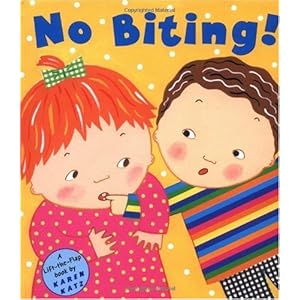
A great book for teaching children about biting

No Biting!

Karen Katz


As many many childcare givers, parents, siblings, grandparents, aunts, uncles, and friends know children of many ages tend to bite.  No not all children do and some are only once while others go through a full phase of it as they grow up.  I have been lucky and never really had to deal with a biting child, at least not for long.  My own son started biting at daycare one day and we were able to stop it right there and then, thank goodness.  On the other hand, now with owning my own daycare I have to learn to deal with this experience more often.  Everyone has there own way of dealing with biting but at the same time, many children just continue biting more matter what happens to them after they have bit someone. 

Through research, I have learned that "most" children bite for a reason.  Whether that reason be frustration, anger, a way to communicate with others, hunger, tiredness.... there are a number of triggers that can lead to a child biting someone.  May child care facilities will have a shadow for the bitter if its something that they can't seem to keep under control.  This shadow is an adult that will more aless follow that single child around all day and watch their reactions and try to find out the trigger for them biting, and hopefully catch them in the early part of the act and stop it then.  As many people own their own in home daycare, one can't always to that, especially if you are the only adult around, with many other children to look after, take care, and comfort.

Biting doesn't only harm the victim but also the predator and even the other children around who witness the act.  As a victim biting usually causes pain, marking, sometimes even the breakage of skin. This child will usually shy away from the biter and even keep to themselves after a while, due to the fact they are scared it will happen to them again.  As a predator (the biter), the issue is that they don't know how to show their emotions in the right matter most of the time.  They get punished for biting, yet the reason they were biting has usually not been dealt with either, because the adult hasn't realized that something needs to be done, besides the punishment.  For the other children that have witnessed the situation, they can be traumatized.  They are scared to play with the predator in case they are the next victim.  No child wants to be bit or hurt and many realize whats going on if they are old enough and will try to keep their distance from trouble that might arise again.

To deal with a biting child many people have taken different steps to stop the situation from happening again.  I have heard of people trying the following situations:
  • taking a favorite toy away
  • time outs
  • isolation of the bitter
  • spanking (if you are one whom still believes in this.  Many consider spanking as child abuse)
  • biting back
  • soap on the lips (I discourage this if possible)
  • hot sauce on the lips (I discourage this if possible)
If you have a young toddler just starting to bite please try the following before you go into anything drastic with punishment.  If its a first time situation of biting, that child might learn from you talking to them and explaining what has gone on and why its wrong.

    1) Firmly say "No bite!" and remove the biting child offender from the situation. 2) Administer an appropriate consequence such as removal of the toy or a time-out for a biting child. 3) Lavish positive attention on the bitten toddler. 4) Use distraction between young kids and watch their interaction closely to avoid placing youngsters--especially one to be known to be a biting child--in a conflict situation. 5) Resist the temptation to bite a biting child back as a way to "show them" their wrongs. Use a positive approach instead. You don't want your toddler telling his teacher that he bites because that's what his parents do!
If you have a child that continues to bite even after explaining what has happened, you might need to take a more stronger approach on the situation to have them stop the biting.  By any means don't go right to the harshest punishment right off the start.  I know its hard to deal with but that biting child is usually tyring to show emotions and just don't know how.  Remember you have to also teach young ones how to tell you or anyone they are angry, hungry, tired, or what ever might be the problem with them. 

Now with the odd ball child that bites for no reason!  You have study the bitter for many, many days, even weeks and just can't seem to find their triggers as to why they bite?!?!  They don't seem to understand biting hurts, they don't stop after you have taken on stronger punishments for them.  What to do?  This is where I need the advice too.  My fellow readers, if you have any idea what to do please let me know!  I am at lost for further information on this part of the subject. 

Tuesday, November 30, 2010

Family Photos

This past Saturday I had a family member take our family photos for us.  Wow, its such a worry for me!  I am a perfectionist in some ways and when I want something done or plan something I worry or don't like when things don't turn out right.  I was so worried taking our 3 children somewhere to get their pictures taken, I wasn't sure it they would behave, if they would smile, cry, be grumpy.  Man I had every situation go through my head and how I would try to deal with it, if it did happen.  We lucked out and the kids were pretty good, my daughter sometimes has a mind of her own and she didn't want to do one of the suggested photo shoots but hey we moved on and I didn't make a big deal over it.  I tried to get her to smell a flower and she just wouldn't, normally I would get upset because its something that should be done and she wouldn't do it.  This time I took a deep breath and we just went on to a new pose and all was fine.  I was prepared for all too (except the good old hair brush! Darn it!).  I packed the lint roller, make up, tide pen, milk and water for the kids, toys, a blanket and even extra shoes.  When you have three kids and all who seem to make a mess with themselves even if they don't have something to eat, I was going prepared and nothing was going to stop these pictures from being taken.  After all said and done I didn't need anything but the blanket really. 

I think its great to have photos done every couple of years at least.  It updates everyone on the growth of your children, its great gifts and will you can't forget the treasure memories!  I like photos that are more natural and not just a still pose with a boring back ground or fake one.  Sure those were nice in the good old days but there are so many talented people out there that take amazing pictures and its nice to see people in a more relaxed setting.  At least this is what I find looks the best, there is nothing wrong with those that go to the well known photo shops and get their pictures taken, some of them turn out great too.  This is my view and I so wish I could take great photo's of my own, as I love pictures of kids and even adults at play.  One day maybe I will take a course or something, but my plate is just a little to full.

So just remember if you decide to take a family or just your child's photo that they are kids.  They might not what that picture taken or do what they should be doing.  Don't stress over it try something else or another time.  You can't make them do it if they don't want to, because it wont turn out or when you look at that photo afterwards it just might break your heart to know how hard it was to get that little smile out of your loved one. 


credit to Angela Klaassen

Sunday, November 28, 2010

Keeping it clean

I have two wee ones in my care one of whom is my own and one that comes in for care.  These two little ones seem to always be sick.  If its not one its the other.  We have had so much go around the daycare since I have open in the beginning of September.  I have dealt with the cold, flu, teething, ear infections, hand-foot-and-mouth disease, and a whole lotta pink eye (both of them have had it twice now).  I clean, clean, and clean and they still pass it around.  As a caregiver and love children it breaks my heart to see one sick.  My oldest son is 6 and between him and my daughter I don't think the two of them together have been as sick as my youngest have and he is only 8 months.  Its been such a task to keep these kidlets healthy.  I thought of not taking sick ones, but I know as a working mom for a few years its hard to always take time off, you need the money, you need the job, but you don't know what to do with your poor little one who is sick and just wants to be held or sleep.  I love the fact that my parents know they can trust their children in my care when they are sick.  I use Lysol almost nightly to try and clean the toys they use, I don't know if I can even count the number of cans I have gone through the last few months just trying to keep up with illnesses.  I thought it might be a good idea to let others know of a few good cleaning tips also.

Choose toys carefully. Look for washable toys and throw out items that won't come clean, Where possible, avoid porous, stuffed or otherwise difficult-to-scrub items.


Wash 'em regularly. You don't need to scrub toys weekly, as many day cares do, but perhaps once a month or at least when toys are visibly dirty. Throw toys into the top rack of a dishwasher or the washing machine, or hand wash them in dish soap and water or if plastic you can use bleach and water. Not all toys indicate whether they're dishwasher safe, so use your judgment. If you're concerned that something might melt, wash it by hand.


Blast germs when required. Disinfect toys and other surfaces (say, toy boxes or crib rails) if you, your child or a visiting playmate has been ill. A bleach-water solution or non-aerosol disinfectant such as Lysol should do the trick (Be sure to read ingredients and labels carefully.) Note that if your dishwasher or laundry machine uses 130-degree water, disinfectant is unnecessary, but if you feel the need to use it, go ahead, its not going to hurt anything but those bad old germs.


Give stuffed toys the deep freeze. If your child has tested positive for dust-mite allergy, put their stuffed toys in a plastic covering and freeze them for three to five hours once a week. "This kills most living dust mites," These microscopic, spider-like mites are one of the most common allergy and asthma triggers. To find out if your child has a dust-mite allergy, ask your family doctor for a blood- or skin-prick allergy test.


Ditch bath toys with holes. Sure, you can and should squeeze water out of tub toys, hang them to dry in a netting bag and wash and disinfect them as above. But bath toys with holes can become a breeding ground for mold, so why not avoid them altogether? I don't always agree with this right away, but once I notice any toys getting that lovely black guck in them then I toss them at that time.  I do know people that will not allow any such things to be used by their child because of the mold, but I also find my children enjoy the good old plastic sour cream contains or the used up bubble bath containers just as much as the actual bath toys themselves.


Keep washing those hands. This is important especially after school or visits to the playground. A recent University of Arizona study found that children's playground equipment and daycare centers were the most frequently contaminated public places of over 1,000 surfaces tested. Washing hands before kids play with their home toys can keep them from spreading bacteria around. "The average child has up to six colds a year, but regular hand washing can cut that in half".  Good news though is that we are more aware of illnesses these days and most people do proper cleaning and hygiene to keep them away.

I have all children in my care wash their hands before and after every meal, after we come inside and of course after they use the bathroom.  I don't always agree on being 100% clean because then your child doesn't get immune to anything and will get sick when out in the public, but at the same time, I do believe in a safe and healthy environment for all.  Kids will be kids and you can't blame any one person on your child getting sick, it just isn't right.  Its not fun to deal with a sick or icky child but take the right measures and most are able to recover with in a few days and are back to their normal busy selves.


Wednesday, November 17, 2010

Why they cry.... it breaks my heart....


So this morning I got a call from a friendly mom from around town that had asked before if I would be interested in take her child from a while during the days she works.  Of course I was happy to say yes, and the call came this morning asking if she could have a "trail" with her little one coming here for a few hours to see how he would react.  After all was said and done, the little man was great, no whine, cry or tear from him.  After talking with his mom for a while about how children can sometimes get very upset with going to daycare, I thought it would be a great topic to blog about a bit.  I know personally that taking your child to daycare for the first time, tenth time, or one hundredth time, can be as hard as ever.  And if they cry, it just makes it even worse on you.  I remember dropping my two oldest children off at daycare and my little girl crying when I left, as I walked to the car I would cry along with her, it just breaks your heart.  I knew she was in good hands because the lady look after my children was a good long time friend of ours, the children knew her well but that didn't matter when it came to leaving and my daughter crying.  Now that I am on the other side of the fence somewhat, I find it just as hard.  I am there with them as they are crying for mommy or daddy, but at the same time, I know how mommy or daddy are feeling too.  When taking on a new child for care its just as hard for me as it is for the parents and the child themselves.  I worry about the fact is this child going to lose it when the parent leaves, I am going to be able to calm them down if so.  What if they don't like it in my care, will I be looked down on as a bad care giver?  There are many different things I worry about the first few days, even up to a week with a new child.  You have to teach them the rules, guide lines, and do's and don'ts of my own house and business, but at the same time you don't want to totally change a young ones life so fast that they aren't sure what is up from down.  So you have to take the time to incorporate both lifestyles for the child for some time, until they are comfortable with you and their new surroundings.

I remember reading over some information on separation anxiety while doing some of my studying for an online child care course.  I went looking through my books to refresh my memory and I thought I would share some in site on why children do this as their parents leave after dropping them off at daycare.

      It is totally normal for a infant or young children to cry when separated from their parents, they simply are unable to understand that their parents will return for them later on.  The reason they don't want you to leave is that you are the one they trust, the person whom knows them and understands their unique style of emotions and communication.  They don't know and understand at first that some one else will also be able to keep them safe and respond to their needs. This is why adjusting to child care can take some time.  Children need to learn through experience that you will come back for them and that the people/person taking care of them are safe, responsive to their needs and nurturing.
     Other reasons a child might cry when being dropped off at daycare my be that the childcare situation is not a good match for them.  This may simply be that the program is to busy and stimulating for your child if he or she is a quieter temperament person or even that the style of the caregiver is not comfortable for your child.  There are times even good programs or day cares aren't a good fit for every child.  This could be reversed too and that maybe the program isn't stimulating enough for you child either, and its not meeting their needs.  The needs and comforting of a child might not be met if there are too many children, not enough teachers/care givers for the amount of children, too small of a space, to large of a space, inappropriate or inadequate materials for your own child's needs.
      The schedule of the day may not be tailored to your child's needs if younger or older then the planned activities are set for.  a program that is so structured that the individual needs of children for food, sleep, play, care giving, and interaction aren't being met is not a healthy place for children to spend their time, and often this frustrates your child and they learn for that feel and get upset when having to be left for any length of time.

Some tips on helping you child adjust to a daycare:
  • carefully check-out and child-care situation before you enroll you child.   You are the one whom knows your child the best, so if you know the daycare program you might be able to view whether it may be to stimulating or not stimulating enough for your child.
  • help your child make the adjustment gradually.  You may want to go with your child once or twice and stay there for a bit with them.  Once they get to know the place, try taking them for short periods of time (1 to 3 hours) by themselves to see how the react while you are gone.  Once your child has been in the care of another person for a few times, it will make dropping the off a little easier sometimes when you are gone for a full day.
  • work towards consistency in a schedule.  This isn't just in the daycare but the routine before going to daycare can help set your child for the day.  Try to keep the routine as predictable as possible, infants and young children can't actually tell time, but if they stay with a routine the learn to know when they are dropped off at day-care that mom or dad will be back to pick them up later.
  • build a strong relationship with the child's caregiver.  Often the caregiver happens to be with your child more hours of a waking day then you might be.  Take the time to talk to your child's caregiver, ask questions on how your child is doing and any problems or success the child has had.
You must remember that your child is not the same as the child sitting 10 feet away.  Every person, infant and child has their own needs, personalities, and comforts.  Even if you take your child to the best, most known daycare around; it doesn't mean its going to be the best for your child.  If crying continues for a long time you might want to try another daycare and see if it might be more comforting and needing for your child.  It doesn't mean that the person looking after you own child wasn't a good caregiver, it just means that both child and care giver's personalities, interests, or the program aren't a match.